
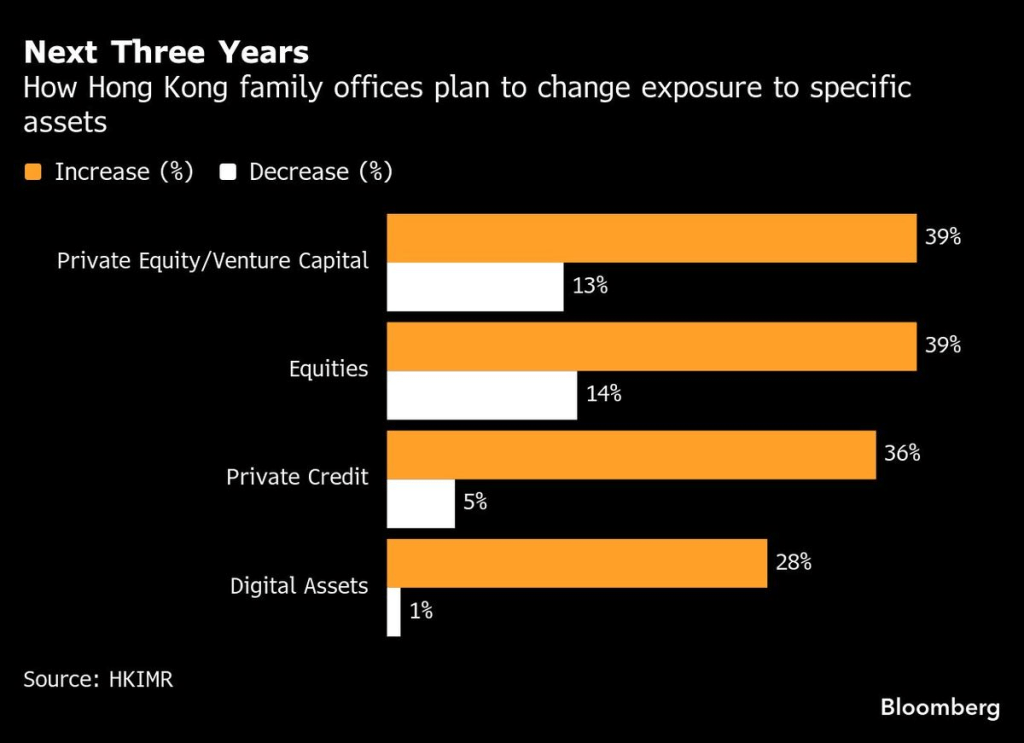
Many Hong Kong-based family offices are planning to add exposure to private equity and digital assets over the next three years, according to a report commissioned by local authorities.
Interest from wealthy families in those assets, alongside private credit and venture capital, are expected to “rise notably”, the Hong Kong Institute for Monetary and Financial Research (HKIMR) wrote on Tuesday.
Hong Kong has sought to encourage more wealthy individuals and their families to anchor their investments in the city, as it aims to be the link between mainland China and global markets. The number of single-family offices based in the financial hub rose to 3,384 by the end of last year, a 25% increase from 2023, according to a Deloitte survey commissioned by the Hong Kong government released last month.
The digital asset market is “growing, but still at an early stage”, Giorgio Valente, the head of the HKIMR, said at a briefing on Tuesday. “Many long-term investors, including family offices, are watching this space and reassessing their positioning.”
The report is based on a survey of 101 entities, including single and multiple family offices, between October 2024 and April 2025. About 44% managed at least US$1 billion ($1.27 billion). Their wealth mostly originated from Hong Kong, mainland China and other parts of Asia.
In line with demands from wealthy investors, Hong Kong’s government has been easing some rules to encourage crypto trading activity. Last year, the city’s Securities and Futures Commission started to license platforms that would be allowed to connect local entities with their global order books.
As part of a three-year push to boost digital assets trading since 2022, the former British colony established a licensing regime for crypto platforms, listed exchange-traded products that track bitcoin and ether, and began to oversee digital-asset funds. Still, crypto activity remains relatively muted compared with hubs such as the US, whose President Donald Trump has embraced the industry.
“While the exact magnitude of those investments remains uncertain, the direction of travel is clear — there’s rising structural interest in this area, and we expect that to deepen over time,” said the HKIMR’s Valente.
Hong Kong Crypto Ecosystem 2.0: Stablecoins, RWA, and the New Battleground for Financial Institutions
In the early stages of the crypto industry, Hong Kong was almost one of the most important entrepreneurial cities in the world.
At that time, a large number of crypto companies chose to establish their headquarters here for a simple reason: Hong Kong has a mature financial system, an international legal environment, and a relatively open capital flow mechanism. These conditions made it an important node connecting Asia and global markets, especially the Chinese-speaking market.
However, this advantage did not last long. As the global regulatory environment tightened, Hong Kong adopted a relatively cautious regulatory strategy in the virtual asset sector. After 2018, the Hong Kong Securities and Futures Commission gradually established a licensing system for virtual asset trading platforms, imposing strict compliance requirements on exchanges, including investor restrictions, fund custody, and operational norms.
From the perspective of an industry still in a state of wild growth at that time, the threshold of this system was too high and would limit access for overseas users. Over five years, only 10 local small and medium-sized exchanges with traditional financial backgrounds obtained exchange licenses. Many large cryptocurrency exchanges chose to leave Hong Kong for jurisdictions with looser regulations.
In 2021, FTX moved its headquarters to the Bahamas, while some trading platforms shifted to Singapore or Dubai. With the departure of these companies, Hong Kong gradually transformed from one of the core cities for crypto entrepreneurship into a relatively marginal participant.
The local track in Hong Kong also failed to form support. Animoca Brands became the most representative crypto company in Hong Kong based on NFTs and GameFi, once regarded as Hong Kong’s Web3 business card, and established a vast ecosystem covering hundreds of projects through investment and incubation. However, as NFT trading volumes collapsed, GameFi economic models failed, and the financing market cooled, Animoca’s growth logic quickly weakened, and its IPO has yet to materialize, significantly diminishing its market influence.
Additionally, the shutdown or exit of Babel Finance, BitCoke, and JPEX also had a negative impact on Hong Kong’s local crypto ecosystem and market education, leading regulatory authorities to further tighten relevant regulatory policies.
As the industry’s core infrastructure and interest communities underwent global restructuring, Hong Kong remained in a state of “regulatory observation – tightening – readjustment.”
New Regulations and Turning Points
The turning point occurred in 2025. In May, Hong Kong passed the “Stablecoin Ordinance” which officially took effect on August 1, aiming to establish a licensing system for fiat-backed stablecoin issuers. The ordinance requires that issuers of stablecoins claiming to be pegged to the Hong Kong dollar must be licensed, emphasizing sufficient asset reserves, customer asset segregation, and prohibition of interest payments.
In June, the Hong Kong government released the “Hong Kong Digital Asset Development Policy Declaration 2.0,” expressing its firm commitment to building Hong Kong into a global leading digital asset center, which also involved specific regulatory agencies, exploration directions, and support policies, greatly boosting the confidence of practitioners in the digital asset field.
At the same time, Hong Kong’s main competitor, Singapore, released new DTSP regulations in May 2025, requiring all crypto service providers to be licensed by the end of June, with a policy direction of “very few licenses” leading to the migration of many companies. The “LEAP” strategic framework launched by Hong Kong at this time—legal regulatory optimization, tokenized product expansion, application scenario promotion, and talent cooperation development—complemented these policies, attracting global crypto resources to converge in Hong Kong.
The crypto market trends and conditions further stimulated the entry of global forces. On one hand, Bitcoin prices continued to rise in 2025, reaching new highs in October; on the other hand, the explosive popularity of concepts like RWA and DAT also prompted major global financial and tech companies like BlackRock and Visa to enter the market, providing a favorable external environment for Hong Kong to vigorously promote the development of the crypto industry.
Today, the main players in Hong Kong’s crypto market are no longer broad hot projects but rather a cluster of local compliant enterprises focused on crypto asset management, stablecoins, and payment sectors.
In the exchange sector, Hashkey Group successfully completed a $200 million IPO and has become one of the most influential crypto companies in the Asian market by covering various aspects such as trading, asset management, Layer 2, and VC. In the payment sector, RedotPay has completed several hundred million dollars in financing and has become the biggest dark horse in the crypto payment field through aggressive strategies in emerging regions. Companies like Avenir Group, First Digital, and Hex Trust have also established solid market competitiveness.
In February 2026, eight ministries and commissions from the mainland jointly issued Document No. 42, clearly prohibiting all RWA tokenization-related activities within the country, while simultaneously opening a compliant channel for overseas RWA, allowing domestic entities to conduct RWA business abroad under regulatory conditions. The document also stated that overseas branches of domestic financial institutions (branches, offices, etc.) could engage in tokenization-related businesses, provided they comply with local laws and Chinese regulatory requirements, fulfilling legal obligations such as high prudence and anti-money laundering.
Considering that most overseas branches of Chinese financial institutions are primarily based in Hong Kong, this regulation further solidifies Hong Kong’s position as a bridgehead in the Chinese-speaking market, making it a key hub connecting mainland regulations with global markets.
For the Chinese-speaking crypto market, Hong Kong’s value is irreplaceable. It serves as both a “compliance springboard” for mainland crypto talent going abroad and a “conversion interface” for global capital entering the Chinese-speaking market. Leveraging its status as an international financial center, it connects compliant crypto assets with global institutional investors. This bidirectional hub role places Hong Kong in a unique “middle ground” in the global crypto industry, distinct from the dominant ecosystem of the U.S. and the grassroots innovation of Southeast Asia, forming a differentiated advantage centered on “compliance, connection, and pragmatism.”
In a sense, Hong Kong is becoming an “offshore testing ground” for China’s crypto industry. This positioning not only meets the development needs of the global digital asset industry but also aligns with the core logic of mainland regulation to some extent. It is this subtle balance that has allowed Hong Kong to regain a unique position in the global crypto regulatory competition.

Do you know what staking is ? Staking on the blockchain refers to the process where participants lock up a certain amount of cryptocurrency to support the operations and security of a blockchain network. In return, they earn rewards, typically in the form of additional cryptocurrency. Staking is often associated with proof-of-stake (PoS) or similar consensus mechanisms used by many blockchains.
