
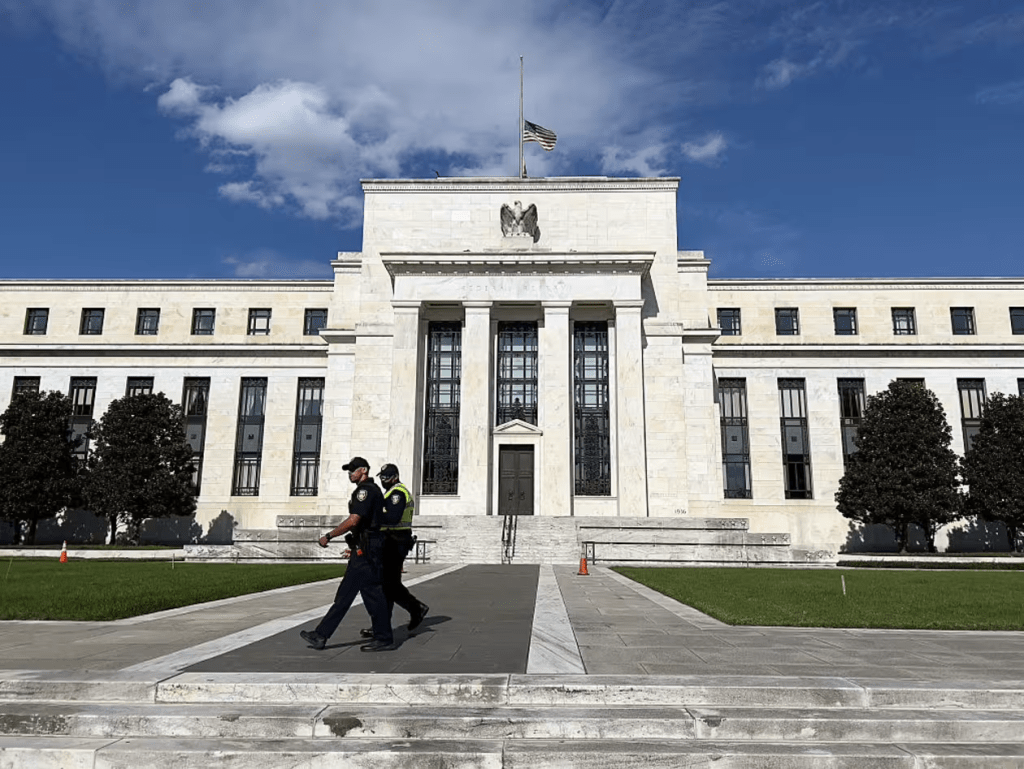
The question of the Fed’s effectiveness is the subject of intense debate between traditional economists and proponents of decentralized finance.
Critics, often from liberal or Austrian economic schools, mainly reproach it for two things:
“Too Little, Too Late”: The Fed is often accused of reacting too slowly (for example, by considering the inflation surge in 2021 as “transitory”).
Moral hazard: By massively injecting liquidity during every crisis (the so-called “Fed Put”), it is said to prevent the natural cleansing of the market, thereby encouraging speculative bubbles.
However, its defenders emphasize that without its massive intervention in 2008 or in 2020 (during the Covid-19 crisis), the global economy could have plunged into a major depression. Its current role is complex: it must manage record levels of public debt while simultaneously fighting persistent inflation.
Will the resolution of these crises involve the use of blockchain ?
Blockchain as a response to crises ?
The idea that blockchain technology could replace central banks is based on several pillars:
Algorithmic monetary policy:
Unlike the Federal Reserve, which can decide to print money at its discretion, a protocol (such as Bitcoin) defines a fixed and predictable issuance schedule, eliminating human error.
Transparency and disintermediation:
Blockchain enables value transfers without going through fragile commercial banks, thereby reducing systemic risk.
Limitations:
The lack of flexibility of a “coded” currency can become a drawback in the event of a major crisis requiring a rapid response. Moreover, the current volatility of crypto-assets prevents them from serving as a stable safe haven in the short term.
Why Cardano Is Well-Positioned (Horizon 2026)
Cardano stands out due to its scientific approach and architecture designed for long-term resilience rather than immediate speculation.
Decentralized Governance (Voltaire Era):
Thanks to its Liquid Democracy model, ADA holders vote directly on protocol updates and treasury usage.
This prevents a small elite (like Fed governors) from unilaterally deciding the network’s economic direction.
Economic Identity (RealFi):
Cardano targets the “Global South” (Africa, Asia) by providing digital identities (Atala PRISM) to millions of unbanked individuals.
By creating a decentralized credit system tied to the real economy, Cardano reduces reliance on failing state financial infrastructures.
Technical Resilience and Scalability:
Unlike other networks that halt during stress peaks, Cardano has proven its ability to maintain uninterrupted block production, even during major technical incidents (e.g., the November 2025 incident).
Solutions like Hydra enable the handling of millions of micro-transactions, crucial for mass economic adoption.
2026 Strategy:
Charles Hoskinson, its founder, positions 2026 as the year of the “great reset,” where real utility (RealFi) will outweigh speculation.
The network now integrates bridges with Bitcoin and privacy solutions like Midnight to attract institutions seeking a secure alternative.

Do you know what staking is ? Staking on the blockchain refers to the process where participants lock up a certain amount of cryptocurrency to support the operations and security of a blockchain network. In return, they earn rewards, typically in the form of additional cryptocurrency. Staking is often associated with proof-of-stake (PoS) or similar consensus mechanisms used by many blockchains.
