

The Central Bank of Brazil has issued new rules for banking institutions and brokers operating with crypto assets in the country. Instruction IN 701/2026 stipulates that they must be certified by an independent company to comply with the established requirements, including the segregation of assets.
Before operating, these institutions will have to engage the services of an independent and qualified firm to certify that they comply with the rules issued by the bank for virtual asset service providers (VASPs).
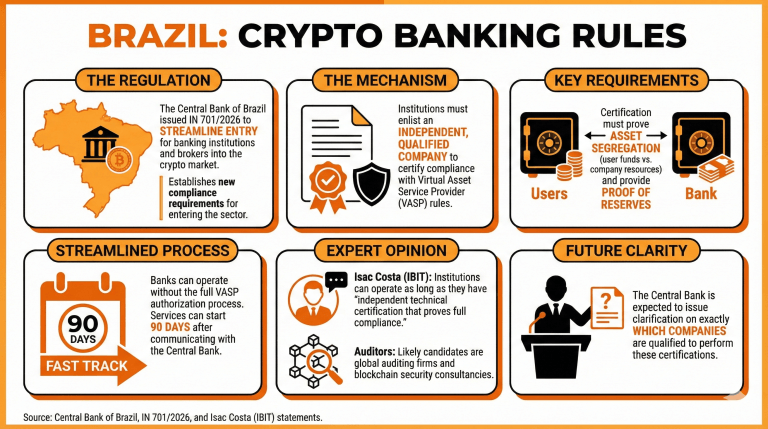
These independent companies must certify that institutions segregate assets, meaning that users’ funds cannot be commingled with the company’s own resources, and must provide proof of reserves for all digital assets held by both clients and the company.
For Isac Costa, professor and director of the Brazilian Institute of Technology and Innovation (IBIT), this means that banks can operate without completing the entire authorization process required for common VASPs, as long as they obtain certification.
“That is, institutions may launch services after 90 days of notifying the Central Bank, provided that this notification is accompanied by an independent technical certification proving full compliance with regulatory requirements,” he told Valor Económico.
Although the rules do not specify which companies will be responsible for certifying institutions, Costa believes that this responsibility will fall to auditors with experience in the cryptocurrency sector.
He believes that “large global audit firms with practices in crypto assets, consulting firms specialized in blockchain system security, and regulatory consulting firms with proven technical capacity in the segment” will fulfill this role.
Nevertheless, it is expected that the Central Bank will provide further clarification on this matter, as these auditors will be key to integrating banking institutions into the crypto industry.

Do you know what staking is ? Staking on the blockchain refers to the process where participants lock up a certain amount of cryptocurrency to support the operations and security of a blockchain network. In return, they earn rewards, typically in the form of additional cryptocurrency. Staking is often associated with proof-of-stake (PoS) or similar consensus mechanisms used by many blockchains.
