
Signs of potential trouble are popping up again in the form of tighter conditions in short-term funding markets, which act as the indoor plumbing of the financial system — and they may require the Federal Reserve to take action relatively soon.
Two measures of funding-market liquidity, known as the Secured Overnight Financing Rate and the Tri-Party General Collateral Rate, have both crept back above 4% during the past week, though remain off their late-October peaks. Both rates are derived from the U.S. overnight repo market, which acts a critical source of short-term funding for a wide range of financial institutions. The Fed monitors pressures in the overnight repo market because of the potential for this to cause wider volatility.
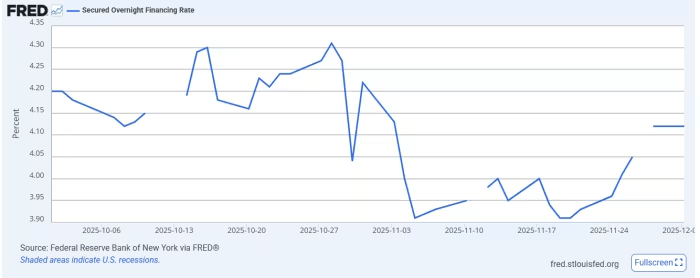
“This, to us, looks like a repeat of the dynamics seen at October month-end,” said Sam Zief, global macro strategist and head of global FX strategy at J.P. Morgan Private Bank. In other words, these developments are “a sign of tighter funding conditions than investors have become accustomed to in recent years, but not a sign of widespread stress.”
Like the days that followed the end of October, “funding conditions are slowly normalizing this week,” Zief wrote in an email to MarketWatch on Tuesday. The bottom line is “liquidity conditions are tighter than they’ve been in recent years, so small shifts in supply and demand can create more visible volatility in money-market rates. That’s not unusual, but it feels more dramatic because we’ve gotten used to extremely stable rates in a world of abundant liquidity.”
Zief added: “We wouldn’t be surprised to see similar activity at future month-ends unless the Fed starts adding liquidity through open-market operations — something they’ll likely do, but probably not until early next year.”
BNY strategist John Velis said “liquidity is getting tight.” Like Zief at J.P. Morgan Private Bank, Velis said he expects the Fed to intervene in funding markets in early 2026 by using open-market operations.
Strategists at TD Securities and Deutsche Bank have both hinted at the possibility that the Fed might need to act even sooner.
Funding strains resurface
Generally speaking, the U.S. central bank’s goal is to keep bank reserves ample or sufficient enough to control short-term interest rates, to provide a cushion against shocks, and to reduce financial institutions’ reliance on the overnight repo market.
Funding markets, which are designed to ensure a smooth and continuous flow of capital, experienced periodic strains in September, as well as at the end of October and November. Tighter conditions in these markets serve as a warning of reduced liquidity and the potential for broader market disruptions.
Concerns now are that liquidity strains may keep coming back despite the end of the Fed’s balance-sheet reduction efforts, which should theoretically be injecting more liquidity into markets.
The pressure now being seen in funding markets, which coincided with the end of November, suggests that reserves are no longer abundant and “may even be scratching the surface of ‘ample,’” said Gennadiy Goldberg, head of U.S. rates strategy at TD Securities in New York. TD sees a rising risk that, in January or potentially even sooner, the Fed will need to announce reserve management purchases, which involve central-bank purchases of Treasury bills as a way to inject more liquidity into the financial system.
Meanwhile, strategists at Deutsche Bank said policymakers could reduce funding pressures by making adjustments to the Interest on Reserve Balances rate, or IORB, which is used by the Fed to keep the fed-funds rate inside its target range. They said they expect this to happen in the first quarter of next year, but noted that others in the market believe it could occur as soon as next week.
The Fed has injected 108 billion into the banking system in two months, a record figure since the dot-com bubble
The Federal Reserve (Fed) provided $13.5 billion (€11.6 billion) to major Wall Street banks in just one day this Monday, according to daily repurchase agreement (repo) data published by the Federal Reserve Bank of New York. This comes amid a widespread surge in these loans granted to these institutions, which have reached $125 billion (€107.503 billion) so far in 2025. To put the figures into perspective, the levels observed over the past two months represent a 32-fold increase compared with the summer of this same year, according to analysis conducted by this newspaper. This increase in volume in recent months is comparable to the burst of the dot-com bubble.
The past two months are among the largest spikes in loans granted by the central bank since the COVID-19 pandemic and represent the second-largest cash injection by the Fed since the health crisis, behind another $24.9 billion (€21.46 billion) granted in October. This instrument is known in English as repos, short-term loans that banks use when they seek to obtain immediate liquidity. The bank requesting this injection, which can be carried out overnight, exchanges Treasury bonds from its balance sheet in return for the loan, which it repays to the central bank the following day.
In addition, this rebound also coincides with the end of the quantitative tightening system (known simply by its initials, QT), a monetary method aimed at reducing the amount of money circulating in the U.S. economy and slowing economic activity. Thus, the Fed has reduced its balance sheet from 8.9 trillion dollars (7.6 trillion euros) to 6.5 trillion dollars (5.5 trillion euros) as recorded at the end of November. These measures seek to reduce the circulation of money in the U.S. economy in order to contain the surge in inflation.

Do you know what staking is ? Staking on the blockchain refers to the process where participants lock up a certain amount of cryptocurrency to support the operations and security of a blockchain network. In return, they earn rewards, typically in the form of additional cryptocurrency. Staking is often associated with proof-of-stake (PoS) or similar consensus mechanisms used by many blockchains.
