
IOG CEO Charles Hoskinson has rejected the accusations of “vibe coding” halting the Cardano blockchain.
“This is an example of a narrative that is wrong on so many levels…” the Cardano founder said in a recent social media post.
“A highly personal attack”
Earlier this week, a stake pool operator submitted a malformed delegation transaction to the Cardano mainnet.
The transaction targeted Charles Hoskinson’s personal stake pool, exploiting a deserialization bug in a cryptographic library dating back to 2022. Newer nodes parsed it incorrectly, while older nodes rejected it.
“It’s a very obscure, arcane bug that came from a library from 2022, and three years later was discovered. So, someone probably pretty smart who is pretty familiar with Cardano stumbled across something and thought that they were being cute and clever. These things happen,” Hoskinson said.
This resulted in a chain split, with the rejected chain rejecting malformed transactions and continuing normally, and the poisoned one causing invalid blocks and a temporary network partition.
Hoskinson has stated that this was “obviously” a highly personal attack.
He has also stressed that the network did not actually go down, and it has shown that it is capable of surviving such “catastrophic” events.
Block production actually continued on both chains, and the network ended up converging via node upgrades.
Vibe coding?
Homer J, the attacker, admitted responsibility on the X social media platform and expressed regret.
He claims that the exploit originated from a personal “challenge,” and AI was used as guidance in his testing, but he ended up misapplying it, which caused network disruption. This created the narrative about vibe coding, the practice of writing computer code with the help of AI tools, halting Cardano.
In his social media post, analyst Nic Carter described the exploit as “some guy vibe coded an exploit which brought down the entire Cardano blockchain.”
However, Hoskinson insists that this narrative is false, and it is undoing ten years of “formal methods, high assurance engineering, and meticulous science.”
Should Those Responsible for Chain Splits Face Legal Action or Should Open-Source Creativity Be Safeguarded ?
Cardano’s network architecture has received public recognition from Solana Co-Founder Anatoly Yakovenko, who applauded its robust design after the blockchain quickly bounced back from a recent chain split. Yakovenko described the blockchain’s durability as “pretty cool” and pointed out the complexities involved in developing a Nakamoto-style consensus protocol without relying on proof-of-work.
Despite the setback, Yakovenko praised the system for operating as intended, stressing that achieving the security level of Bitcoin without the high energy demands of proof-of-work is uncommon among proof-of-stake (PoS) blockchains.
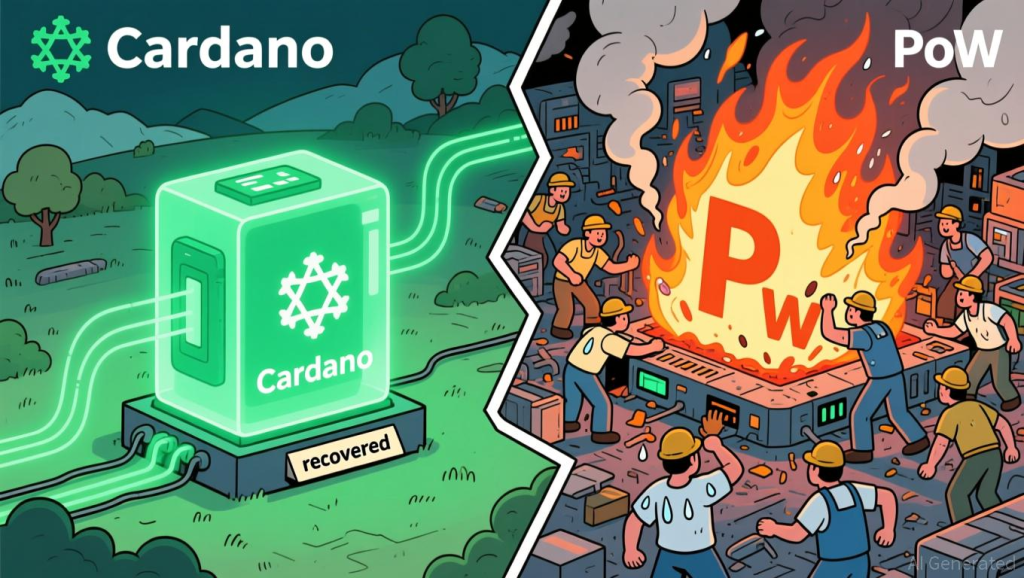
Cardano’s swift restoration was made possible by its Ouroboros consensus protocol, which is designed for energy efficiency and ensures the “honest chain” prevails during splits experts say. The network managed to avoid both a full rollback and a hard fork, keeping transactions running smoothly and safeguarding user funds, according to Cardano founder Charles Hoskinson as mentioned in reports.
Yakovenko remarked that this was a clear example of “a decade of formal methods proving their worth at a critical moment,” and noted that most PoS blockchains would find it difficult to recover from such incidents without outside help.
The chain split also ignited a public discussion between Hoskinson and Yakovenko about whether the event should be handled as a criminal case. Hoskinson maintained that the attack—carried out by a dissatisfied stake pool operator (SPO) who exploited testnet weaknesses—deserved legal consequences, claiming it inflicted “catastrophic harm” on the ecosystem. In contrast, Yakovenko warned that prosecuting the perpetrator could discourage open-source innovation, cautioning that excessive regulatory action might stifle progress in permissionless networks as he explained. Hoskinson, on the other hand, argued that deliberate attacks on public blockchain infrastructure should be prosecuted as federal crimes, drawing comparisons to the risks faced by regulated financial platforms built on blockchains such as Solana.
Cardano’s effective management of the situation has strengthened its standing as a resilient PoS blockchain. Observers pointed out that the fork demonstrated the network’s capacity to self-heal without stopping operations, which is rare in the cryptocurrency sector. The forthcoming Leios upgrade, planned for 2026, is expected to automate similar recovery mechanisms, further enhancing Cardano’s security infrastructure development updates show. Hoskinson also revealed the upcoming launch of the Midnight sidechain’s NIGHT token in December 2025, as part of broader initiatives to grow Cardano’s ecosystem.
Yakovenko’s commendation reflects increasing mutual respect among blockchain leaders, but the incident also underscores persistent challenges in protecting PoS networks from targeted attacks. The ongoing debate about legal responsibility raises important questions about how to balance network resilience with regulatory measures in decentralized systems industry. For now, Cardano’s rapid response has boosted confidence in its architecture, with some suggesting its model could become a standard for future PoS advancements.

Do you know what staking is ? Staking on the blockchain refers to the process where participants lock up a certain amount of cryptocurrency to support the operations and security of a blockchain network. In return, they earn rewards, typically in the form of additional cryptocurrency. Staking is often associated with proof-of-stake (PoS) or similar consensus mechanisms used by many blockchains.
