

Cardano has reached a turning point in its history: since September, the network has operated under a fully on-chain governance structure, community-elected and powered by smart contracts.
This transformation marks the conclusion of the Voltaire era — the final stage in the protocol’s roadmap — focused on institutional decentralization and citizen control over ecosystem funds and decision-making.
WHAT CHANGES WERE MADE?
The shift began with the election of the first Constitutional Committee (CC), composed entirely of community-led organizations, including the Cardano Atlantic Council, Tingvard, and the Eastern Council. The vote was conducted publicly and verifiably in September, following the guidelines of CIP-1694, which requires concurrent majorities of 67% from Delegated Representatives (DReps) and 51% from Stake Pool Operators (SPOs). With the new committee taking office, the founding entities — IOG, EMURGO, and the Cardano Foundation — formally relinquished control over the governance process.
In parallel, Cardano deployed a smart contract–based Treasury that automates community fund allocation and replaces administrative management with auditable logic. Each withdrawal requires multiple signatures and constitutional approval before execution. Oversight is carried out by a Supervisory Committee composed of five independent entities — Sundae Labs, Xerberus, NMKR, DQuadrant, and the Cardano Foundation — which verify every transaction without participating in political decisions.
CARDANO MADE ITS FIRST LARGE-SCALE ALLOCATION THROUGH A DIRECT VOTE
The system was tested in July, when Intersect submitted 39 withdrawal requests to fund maintenance and infrastructure. Each payment was executed in under 36 hours, proving that a decentralized model can match the efficiency of centralized systems without sacrificing transparency.
A month later, the community approved the first large-scale allocation: 96 million ADA (about $71 million) to fund upgrades to Ouroboros Leios, Hydra, and Mithril. It was the first time that the network’s core development was financed directly by community vote rather than from the founders’ treasury.
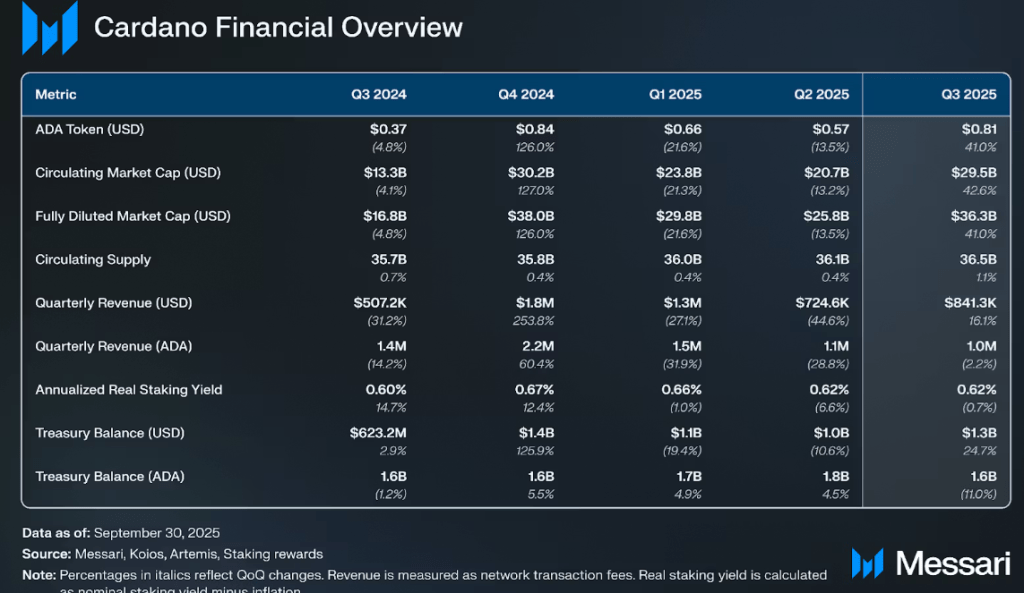
The new structure introduces a formal separation of powers between DReps, SPOs, and the Constitutional Committee, which now function respectively as the legislative, executive, and judicial branches within the network. With these changes, Cardano leaves behind the foundation-led model and becomes a self-governing political system where every ADA holder can influence the evolution of the protocol.

Do you know what staking is ? Staking on the blockchain refers to the process where participants lock up a certain amount of cryptocurrency to support the operations and security of a blockchain network. In return, they earn rewards, typically in the form of additional cryptocurrency. Staking is often associated with proof-of-stake (PoS) or similar consensus mechanisms used by many blockchains.
