
Discover x402, Coinbase’s open payment protocol that allows bots and AI agents to pay for services in real time using USDC.
Coinbase has brought back the classic HTTP 402, but in crypto mode: x402 is an open protocol that allows bots and AI agents to pay for real-time services using crypto.
The agent itself makes the request, receives the response with the payment terms, settles in USDC on the Base network — and that’s it. No APIs or third parties required.
On the Cardano network, the x402 protocol has been integrated — a technology developed by the exchange Coinbase, designed to allow artificial intelligence (AI) agents and applications to execute payments between each other over the internet without relying on accounts, passwords, or traditional authentication systems.
Google has supported x402 by incorporating it into its Agent Payment Protocol (AP2), a tool meant to streamline transactions between AI agents, where x402 functions as an add-on that enables those payments.
The x402 protocol acts as an extension of the HTTP standard (HyperText Transfer Protocol — the same one used by web browsers), but with the ability to embed cryptographic transactions directly into the web.
Instead of creating new payment infrastructures, x402 leverages the existing internet network to enable micropayments and automatic transfers between machines or digital services, making it a key tool for the AI-driven autonomous agent economy.
In this context, integration with Cardano allows applications built on this network to use x402 as a payment layer, enabling smart programs or automated agents to send and receive payments in ADA or tokens issued on Cardano.
In practice, this broadens the development possibilities within Cardano.
Charles Hoskinson, CEO of Cardano, described this integration as “very good” for the network in a post on social platform X on October 27.
Hoskinson’s comment came in response to a post by Patrick Tobler, CEO of Masumi, who that same day had announced progress in the integration between x402, Cardano, and Masumi.
Masumi is an infrastructure platform built on Cardano that allows users to create, test, and deploy decentralized applications (dApps) and tokens using open-source tools.
Its connection with the x402 protocol lies in serving as a testing environment to verify communication between Cardano and the artificial intelligence layer provided by Coinbase.
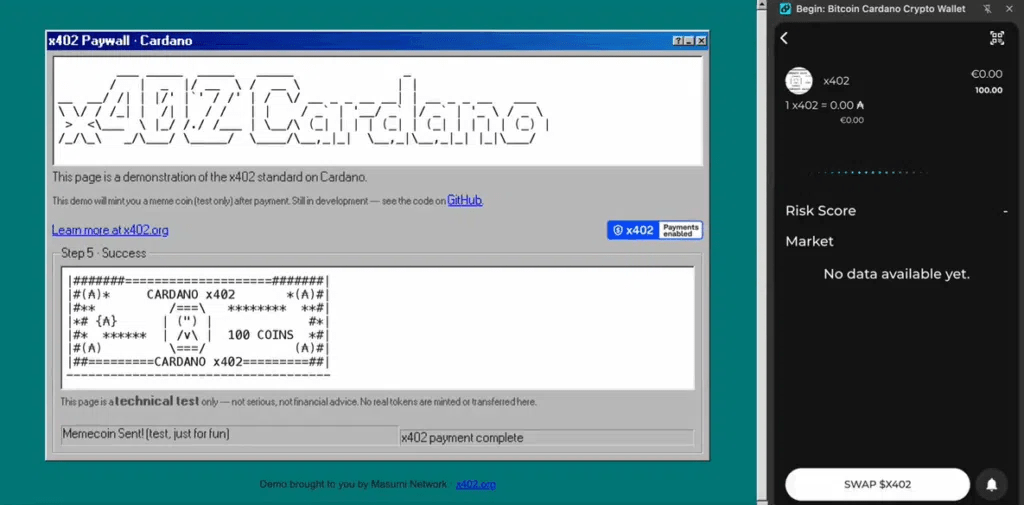
In his post on October 27, Tobler explained that the team had achieved an initial proof of concept, called Memecoin Mint, which is accessible on their website.
There, users can mint an experimental token that requires “2 USDM (a Cardano stablecoin) and some ADA to cover network fees,” according to Tobler.
This proof of concept means that a technical demonstration of the integration of x402 into Cardano has been achieved, through the creation of a memecoin as evidence that the protocol can be used to carry out payments and mint digital assets in a decentralized and automated way.
Alliance between Coinbase and Cloudflare
The system is agnostic to any network, designed to integrate seamlessly with any service. Even Cloudflare has partnered up, meaning it now natively supports x402 across its serverless and agent-based platforms. In practice, developers can offer premium resources, APIs, or on-demand services, and bots pay for and consume them autonomously—without human intervention.
The current x402 hype has two distinct sides: the memecoin side, full of memes and instant launches, and the AI side, where autonomous agents are beginning to move money and resources as if they were humans—but much faster.
X402: AI and meme cryptocurrencies
On one hand, the memecoin sector has given rise to what some call the “HTTP-native Fair Launch Meta”: developers publish a URL, users mint tokens instantly via the web, and they receive them immediately on-chain. It’s a very fast process that allows people to buy new memes quickly.
In fact, launchpads are already emerging that let users create memecoins via x402 with no complications, and the community’s attention is focusing on these viral “HTTP mints.”
On the other hand, the AI sector is even more interesting in the long term. AI agents, integrated with x402 and orchestration platforms like $SANTA or $KARUM, can coordinate with each other, find the right resources, pay automatically, and ensure that tasks are completed correctly.
Before this innovation, all of this required accounts, credit cards, KYC, manual transfers, and huge fees to intermediaries like Stripe. Now, it’s instant and seamless.
Adoption of x402 has exploded since May, especially after the push from Google and Cloudflare, who are promoting the standard globally. This opens the door for web2 and web3 agents to operate fully autonomously, conducting all kinds of service transactions instantly.
The future of autonomous AI agents
It is projected that autonomous transactions could reach $30 trillion by 2030, giving an idea of the magnitude of the ecosystem being created.
Ethereum is currently the platform of choice for x402, thanks to its robust and secure infrastructure capable of supporting the massive volume of transactions generated by agents. However, experiments are also being conducted on Solana.
If x402 manages to consolidate, it could become the standard for autonomous crypto payments—on par with Bitcoin and Ethereum in their time.
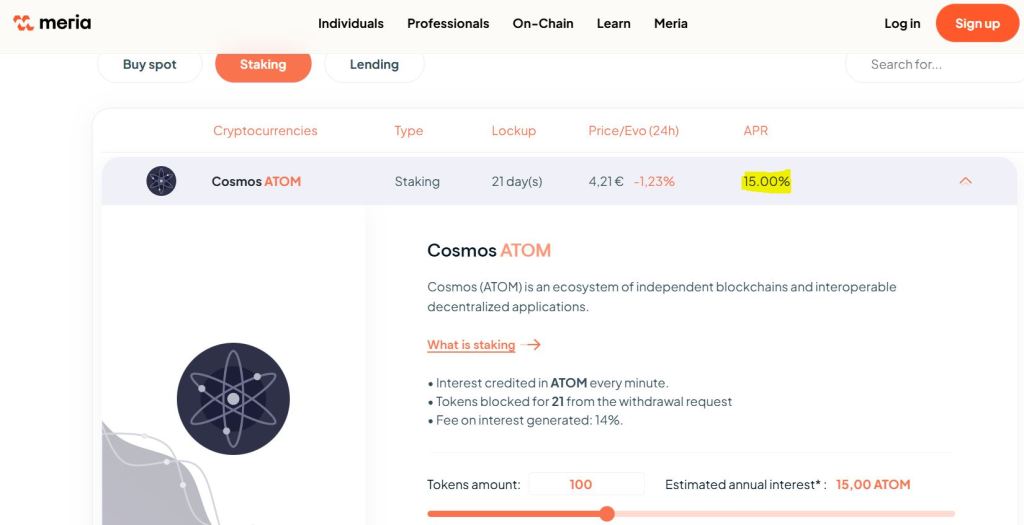
Do you know what staking is ? Staking on the blockchain refers to the process where participants lock up a certain amount of cryptocurrency to support the operations and security of a blockchain network. In return, they earn rewards, typically in the form of additional cryptocurrency. Staking is often associated with proof-of-stake (PoS) or similar consensus mechanisms used by many blockchains.
