
Bitcoin DeFi will surpass Ethereum DeFi, and the awakening of the giant will occur in 3 to 5 years, believes the founder of Cardano.
Charles Hoskinson shared his thoughts on decentralized finance on Bitcoin in an interview with CoinDesk, published on September 9, 2025. For the founder of the Cardano network, Bitcoin DeFi is a “sleeping giant.” Its awakening, which he predicts will occur within 3 to 5 years, would mean the concentration of a total value locked (TVL) of hundreds of billions of dollars.
According to Hoskinson, Bitcoin DeFi will be larger than Ethereum’s market capitalization and will have more liquidity from sovereign wealth funds and corporations like BlackRock, which will engage in the network’s on-chain finance.
Additionally, he believes there is no reason to use Ethereum, Cardano’s direct competitor, to scale Bitcoin, and considers that either Bitcoin itself or a Layer 2 solution like Stacks will be responsible for driving the DeFi ecosystem of the leading cryptocurrency.
This is not the first time Charles Hoskinson has spoken about decentralized finance on Bitcoin. The first obstacle to the growth of DeFi on Bitcoin is the absence of an executive authority capable of driving these ideas in the ecosystem, says the CEO of IOHK.
But once these obstacles are overcome, Bitcoin would be like “discovering North America, a virgin territory” for decentralized finance.
This is happening in a context where Solana, Ethereum, Aptos, and Sui are competing for the same limited territory, the developer believes. These applications would have reached the inherent limit of their current adoption, a limit that Bitcoin could easily surpass due to its superiority in this regard.
According to Charles Hoskinson, the essential questions about DeFi on Bitcoin are as follows: How can a stablecoin be created on Bitcoin? How can a decentralized exchange be established on its network? What technologies are needed to make decentralized finance on Bitcoin a reality? In answering this question, he suggests that Taproot and BitVM are two technologies that could help achieve it.
There would be one more obstacle to overcome: building a user experience suited to the preferences of a Bitcoin maximalist. Hoskinson believes there are three rules to achieve this: security based on Bitcoin’s infrastructure, payments in bitcoin, and capital gains paid in bitcoin.
Despite what the Cardano founder says, there are already several DeFi solutions on Bitcoin through sidechains, L2s, and more, such as Rootstock, Stacks, or Botanix. However, these solutions are fragmented, and Hoskinson believes that Cardano and projects like Midnight could hold the answer to this fragmentation.
Bitcoin DeFi will receive a Cardano stablecoin
Sundial Protocol and USDM, a stablecoin created for DeFi on Cardano, have announced a collaboration aimed at integrating Sundial’s Bitcoin layer-2 infrastructure with the stablecoin. The agreement, disclosed on September 10, 2025, seeks to explore new possibilities in the Bitcoin-based decentralized finance (DeFi) ecosystem from the Cardano network.
The objective of this partnership is to combine USDM’s liquidity with Sundial’s technology to develop yield products in Bitcoin.
The Sundial website claims that this is the “first UTXO-native layer 2” and a network based on regulatory compliance.
UTXO means “Unspent Transaction Output,” which is the fundamental model Bitcoin uses to track ownership of funds. A “UTXO-native” solution implies that this technology is designed specifically to work with Bitcoin’s UTXO model, which is why Sundial does not issue any token and uses BTC as the native currency of the protocol.
According to Sam Delaney, the company’s technology lead, the UTXO model with Bitcoin-based “transactional determinism” facilitates the formal verification of decentralized applications (dApps) and of the Sundial protocol itself:
Basically, it mathematically proves that a smart contract works as advertised and does not present security vulnerabilities. Previously, such formal verifications were extremely costly, but we hope to leverage one of the new available tools so that teams can carry them out much faster and more cost-effectively.
—Sam Delaney, Protocol Technology Lead
USDM was created by Moneta, a company innovating in the stablecoin sector within the Cardano network :
“USDM serves as a base asset for decentralized finance (DeFi) protocols and enables instant on-chain payments, accelerating the growth and adoption of the entire Cardano ecosystem (…). USDM is backed 1:1 by USD bank deposits and money market funds managed by Fidelity and Western Asset Management, ensuring stability and security for all users.“
Moneta, a company focused on stablecoins.
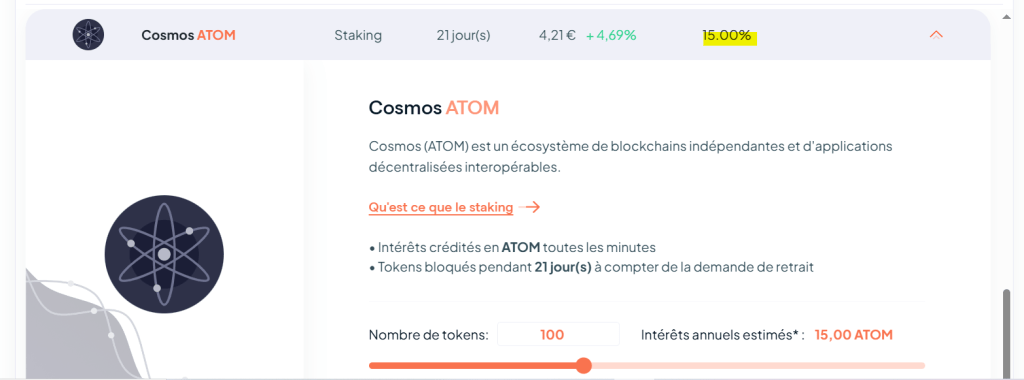
Do you know what staking is ? Staking on the blockchain refers to the process where participants lock up a certain amount of cryptocurrency to support the operations and security of a blockchain network. In return, they earn rewards, typically in the form of additional cryptocurrency. Staking is often associated with proof-of-stake (PoS) or similar consensus mechanisms used by many blockchains.
