

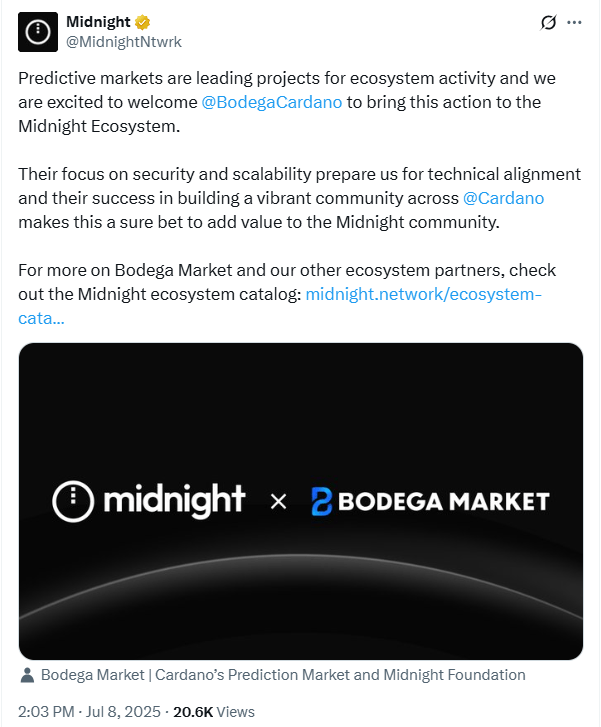
Cardano Midnight Network has announced the integration of Bodega Market, a competitor to Polymarket.
This significant integration took place within the Midnight Ecosystem, marking a direct partnership between the Midnight and Bodega teams.
The goal is to expand prediction markets and boost user engagement within the Cardano ecosystem.
The integration brings prediction markets to Cardano’s Midnight ecosystem
In a recent post on X, the Cardano Midnight Network announced the integration of Bodega Market into its system on July 8, 2025.
Bodega, a competitor of Polymarket, joined the Midnight Ecosystem after the two development teams collaborated for weeks.
The goal was to introduce new features that would improve the network’s usability for users.
It is worth noting that with the integration, users can now participate in prediction markets through Bodega.
These markets allow individuals to place bets on future events, including political outcomes or global trends.
The platform used USDM, a stablecoin on the Cardano network, to place and settle bets.
All transactions were recorded on the blockchain for greater transparency and accountability. Additionally, smart contracts are used to manage payments once event outcomes are confirmed.
This setup helped ensure fairness and speed in payments. The partnership aligns well with Midnight’s focus on privacy and scalability.
Bodega had already demonstrated strong performance on Cardano, making it a solid choice.
The teams worked closely to ensure both systems could operate together smoothly. Community members were also involved in the process to provide feedback.
It is also important to note that the integration details have been added to Midnight’s website catalog.
The listing explained the reasons behind the move and demonstrated its connection to other parts of the ecosystem.
The partnership followed a growing trend in blockchain, where networks collaborate to share tools and attract more users.
Collaboration and technical alignment of the Cardano Community
The decision to incorporate Bodega into the Midnight Ecosystem was based on shared goals.
Both teams aimed to improve the user experience and foster growth within their networks. This type of partnership is increasingly common in the blockchain world.
To provide context, platforms and projects often collaborate to build better products, as seen with BlackRock and Securitize in the emergence of BUIDL.
Bodega brought several features to Midnight, including real-time bet tracking. This allowed users to adjust their bets as the odds changed.
The goal was to make the platform more active and attractive to a wide range of users.
Governance votes helped shape the new types of markets that were added. Midnight’s connection with Cardano also influenced the decision.
Midnight’s strong on-chain privacy tools worked well with Bodega’s setup. The teams spent time solving technical issues such as data protection and network speed.
Community input played an important role in these final changes. The entire process took several weeks of planning and testing, according to the update.
The online response showed that many users welcomed the move positively. People saw it as a positive change that could make the ecosystem competitive with Polymarket on Polygon.
Implications for the future growth of ecosystems
It is also important to note that adding Bodega may impact the future development of the Midnight Ecosystem.
Leaders hinted that more partnerships could occur before the end of 2025.
These would likely focus on tools that protect user data, support a larger number of users, and increase market adoption.
Midnight is also preparing for new European regulations affecting how data is managed. Perhaps that is why privacy is a key focus for the ecosystem’s innovators.
The network operates with two tokens: NIGHT, which handles voting and rewards, and DUST, which supports transactions.
These could find frontline uses on Cardano and in broader prediction markets.
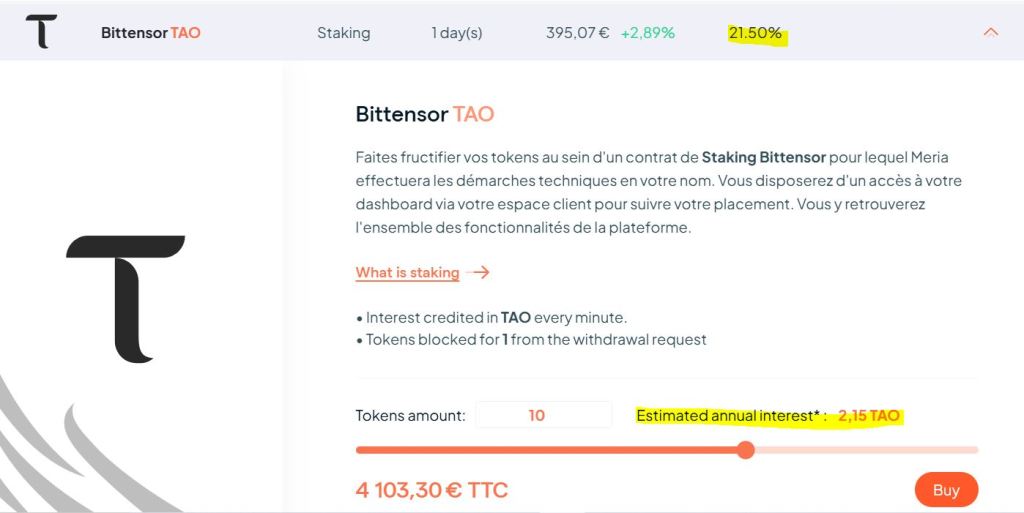
Do you know what staking is ? Staking on the blockchain refers to the process where participants lock up a certain amount of cryptocurrency to support the operations and security of a blockchain network. In return, they earn rewards, typically in the form of additional cryptocurrency. Staking is often associated with proof-of-stake (PoS) or similar consensus mechanisms used by many blockchains.
