
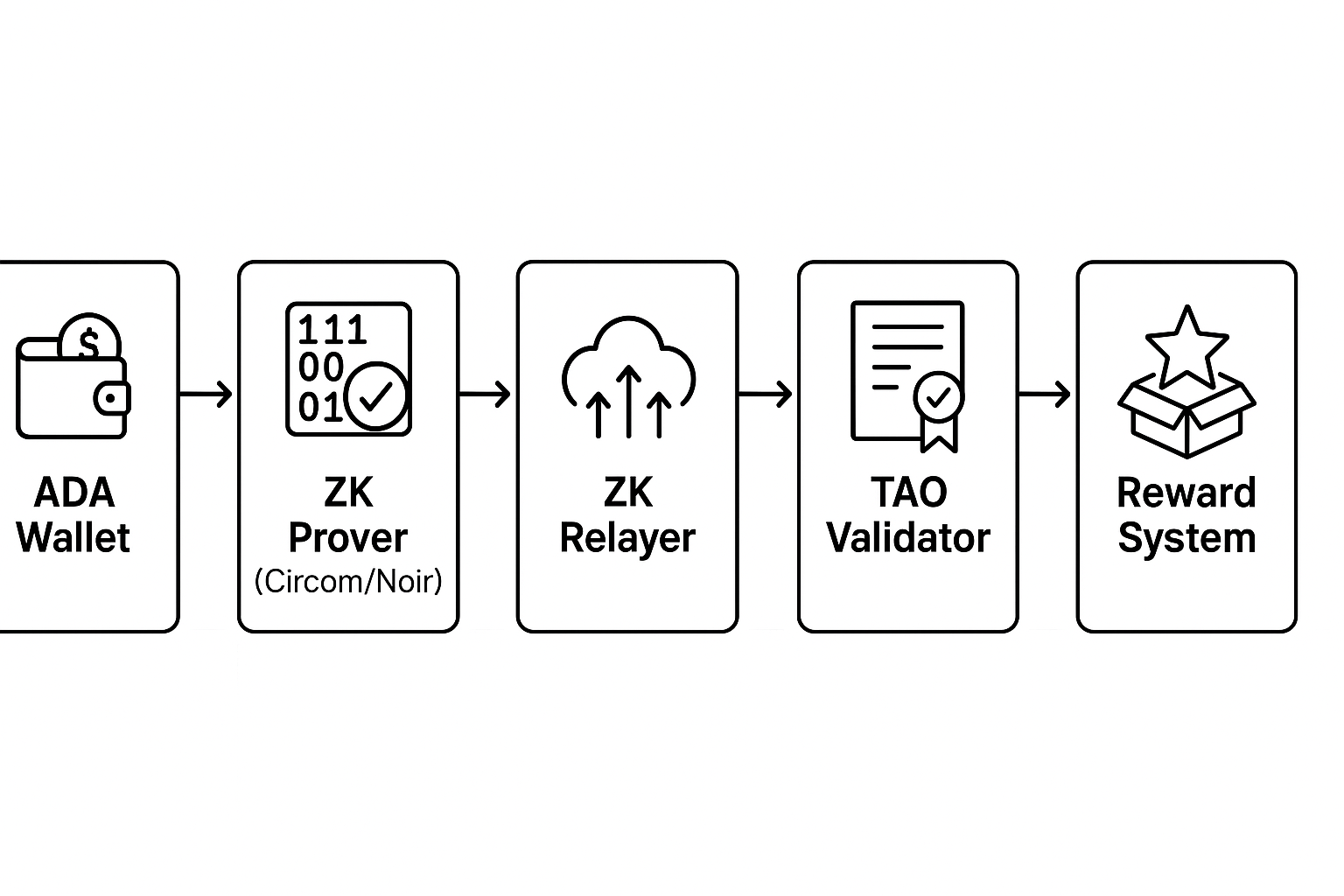
🧭 Overview
This project explores a novel interoperability concept: enabling the staking of ADA (Cardano’s native token) on the TAO network (Bittensor) using zero-knowledge proofs (ZKPs) and a verifiable Cardano staking certificate format. The aim is to bridge two advanced blockchain ecosystems—Cardano, known for its academic rigor and UTxO model, and Bittensor, the decentralized AI network powered by TAO.
🔍 Objective
To design a technical framework and prototype that:
- Allows Cardano users to prove their ADA staking commitment off-chain
- Enables Bittensor subnet validators or services to verify these commitments
- Offers cross-chain staking incentives, encouraging capital flow from Cardano into Bittensor’s AI economy
🏗️ Key Components
- Cardano Staking Certificate Format
- Uses CIP-68-compliant metadata and NFT binding
- Signed proof-of-stake ownership without revealing wallet contents
- Zero-Knowledge Proofs
- ZK-SNARKs or Bulletproofs to anonymize and compress staking claims
- Validated by Bittensor’s off-chain infrastructure or smart contracts (future support)
- Bittensor Integration Layer
- Middleware or light-client that reads ZK-certified staking data
- Optionally adjusts TAO staking weights or reputation scores
To implement Cardano Certificate Format for staking ADA to Bittensor (TAO) using a technical process, you’ll need to:
- Understand Cardano’s staking system (certificate structure and delegation mechanics),
- Translate the staking intent into a format understandable by Bittensor,
- Apply zero-knowledge proofs (ZKPs) or verifiable credentials (if applicable) to prove staking without revealing sensitive data,
- Develop a mechanism on Bittensor (TAO) to verify and trust the Cardano staking claim.
✅ Phase 1: Understand Cardano Staking Certificate Format
Cardano uses signed staking certificates in its transaction metadata. There are 3 main types:
stake_key_registration_certificatestake_delegation_certificatestake_deregistration_certificate
They are serialized in CBOR (Concise Binary Object Representation) and typically generated using cardano-cli.
🔧 Sample Command to Generate Delegation Certificate
cardano-cli stake-address delegation-certificate \
  --stake-verification-key-file stake.vkey \
  --cold-verification-key-file pool.vkey \
  --out-file delegation.cert
The .cert file includes:
- Stake key hash
- Pool ID (hex)
- Network ID
✅ Phase 2: Extract and Validate Delegation Info
You’ll want to:
- Parse the delegation certificate.
- Verify that the stake address is indeed delegating to a valid pool.
- Confirm the delegation is active on-chain via Cardano node or explorer API.
Tools
cardano-cli query stake-address-info- Cardano GraphQL or Koios API
✅ Phase 3: Prove Ownership (Zero-Knowledge or Verifiable Claim)
Now, to bridge to TAO, implement one of the following:
Option A: Zero-Knowledge Proof (ZKP)
You design a ZKP circuit that proves:
- “I own a Cardano stake address that has delegated X ADA to pool Y at slot Z.”
Possible ZKP Tools:
Inputs:
- Public stake address
- Delegation slot number
- Signature proving ownership (Ed25519)
Circuit Outputs:
- Boolean (valid delegation)
- Proof
Option B: Signed Verifiable Claim
Instead of full ZKP, you create a verifiable credential like:
jsonCopiarEditar{
  "stake_address": "stake1u...",
  "delegated_to": "pool1abc...",
  "amount": 10000,
  "timestamp": 12345678,
  "signature": "ed25519..."
}
Then publish this claim on IPFS, Cardano metadata, or a TAO subnet.
✅ Phase 4: TAO (Bittensor) Side – Validate and Register
Option A: TAO Subnet Integration
Build or modify a Bittensor subnet that:
- Accepts the certificate/proof as input
- Verifies ZKP or signed credential
- Maps valid Cardano stake to TAO staking rights
Option B: Smart Contract (if EVM-compatible)
Use a smart contract on a layer connected to Bittensor that:
- Verifies the Cardano certificate
- Mints a wrapped stake token (e.g.,
wADA-staked) - Allows staking into TAO ecosystem with this token
✅ Example Workflow Summary
- User delegates ADA to a specific pool on Cardano.
- User generates staking certificate using
cardano-cli. - User signs proof of ownership, optionally with a ZKP.
- User submits proof to TAO subnet or verifier.
- Verifier validates and grants equivalent TAO access/stake.
⚠️ Considerations
- Cross-chain trust: How will TAO trust the Cardano chain state?
- Proof freshness: How often should the delegation be re-verified?
- Security: Ensure no double-staking or falsified delegation.
- Privacy: If using ZK, minimize public exposure of wallet activity.
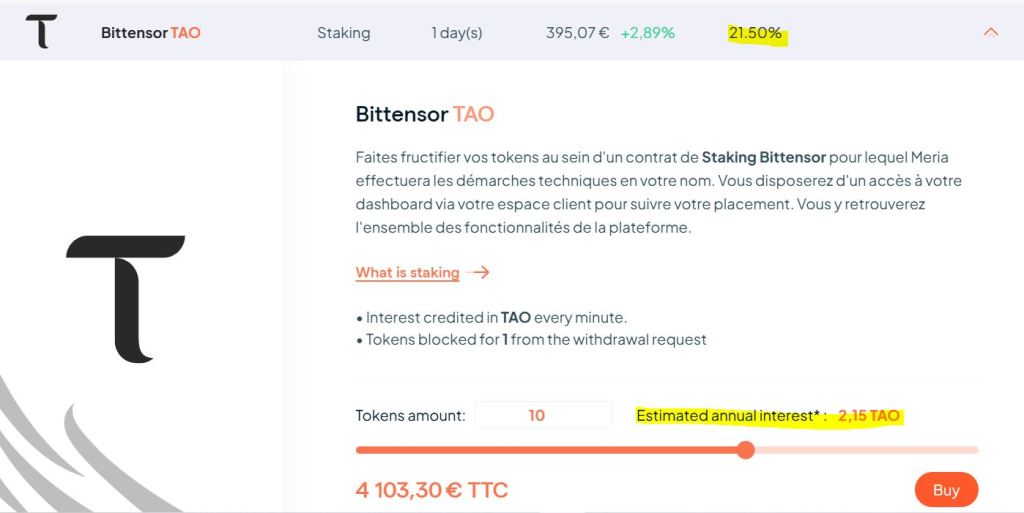
Do you know what staking is ? Staking on the blockchain refers to the process where participants lock up a certain amount of cryptocurrency to support the operations and security of a blockchain network. In return, they earn rewards, typically in the form of additional cryptocurrency. Staking is often associated with proof-of-stake (PoS) or similar consensus mechanisms used by many blockchains.
