
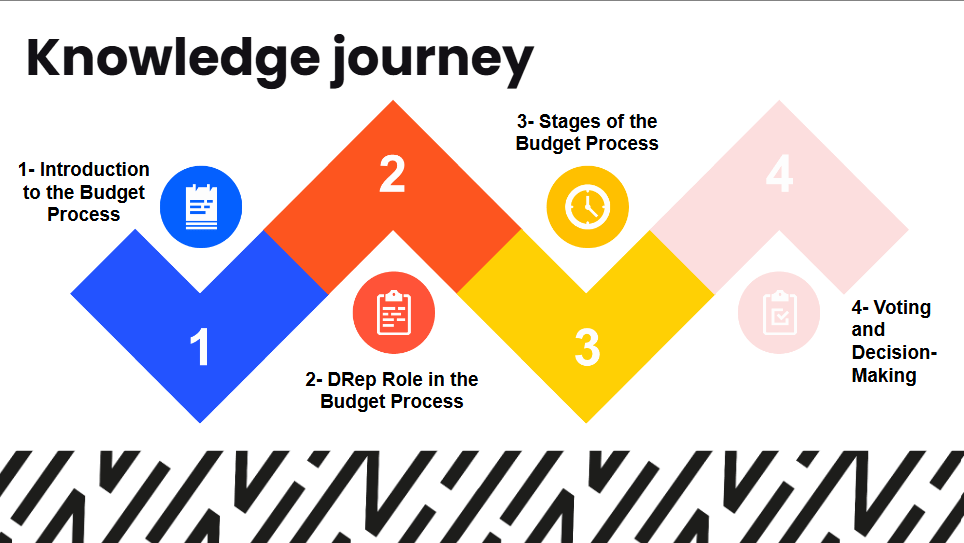
This staged approach gradually builds knowledge from basic concepts to complex processes.
In the Cardano budget process, the budget is divided into five primary “buckets,” each with a specific purpose aligned with Cardano’s strategic and operational goals:
- Core Development: Funds essential operations and technical improvements, maintaining and expanding Cardano’s core blockchain features.
- Governance Support: Provides resources for governance structures, including DReps and Constitutional Committee activities, to uphold Cardano’s decentralized governance.
- Research: Supports ongoing blockchain research and innovation.
- Outreach and Education: Promotes Cardano through educational programs, community engagement, and global outreach to expand adoption and understanding.
- Community Grants: Allocates funds for community-led projects and initiatives, to foster ecosystem growth through decentralized innovation.
Each bucket is strategically defined to ensure Cardano’s continued development, governance, and community involvement in a balanced and impactful way.

DRep Role in the Budget Process
In the Cardano budget process, DReps (Delegated Representatives) play a crucial role in budget approval and oversight. Their responsibilities include:
- Reviewing Budget Proposals: DReps examine proposed budgets, ensuring alignment with Cardano’s strategic goals and community priorities.
- Providing Feedback: They engage in feedback cycles with the Budget Committee to refine proposals, particularly during socialization stages.
- Voting on Final Approval: DReps participate in voting to approve or reject budgets and other financial actions.
- Monitoring Quarterly Reports: DReps review quarterly financial reports to maintain accountability and transparency for approved spending.
This process ensures that DReps represent community interests and uphold the transparency of Cardano’s financial planning.
Voting and Decision-Making
In the Cardano budget process, the voting and decision-making steps involve DReps and the Constitutional Committee (CC) and are structured as follows:
- Proposal Review and Socialization: Budget proposals are first socialized, with DReps and CC members providing feedback to refine and align them with community priorities.
- Final Voting: DReps, along with the CC, review the finalized proposals and vote on approval or rejection. A majority vote typically determines the outcome.
- Post-Approval Monitoring: Approved budgets undergo regular quarterly reviews, allowing DReps and the CC to ensure funds are used as intended. This transparency maintains community trust and adherence to the agreed budget.
This system empowers DReps to represent community interests in a structured, accountable manner.

Do you know what staking is ? Staking on the blockchain refers to the process where participants lock up a certain amount of cryptocurrency to support the operations and security of a blockchain network. In return, they earn rewards, typically in the form of additional cryptocurrency. Staking is often associated with proof-of-stake (PoS) or similar consensus mechanisms used by many blockchains.
Partners :
Cardano Use Case : Creation of a custom academic credentialing solution with Identus
